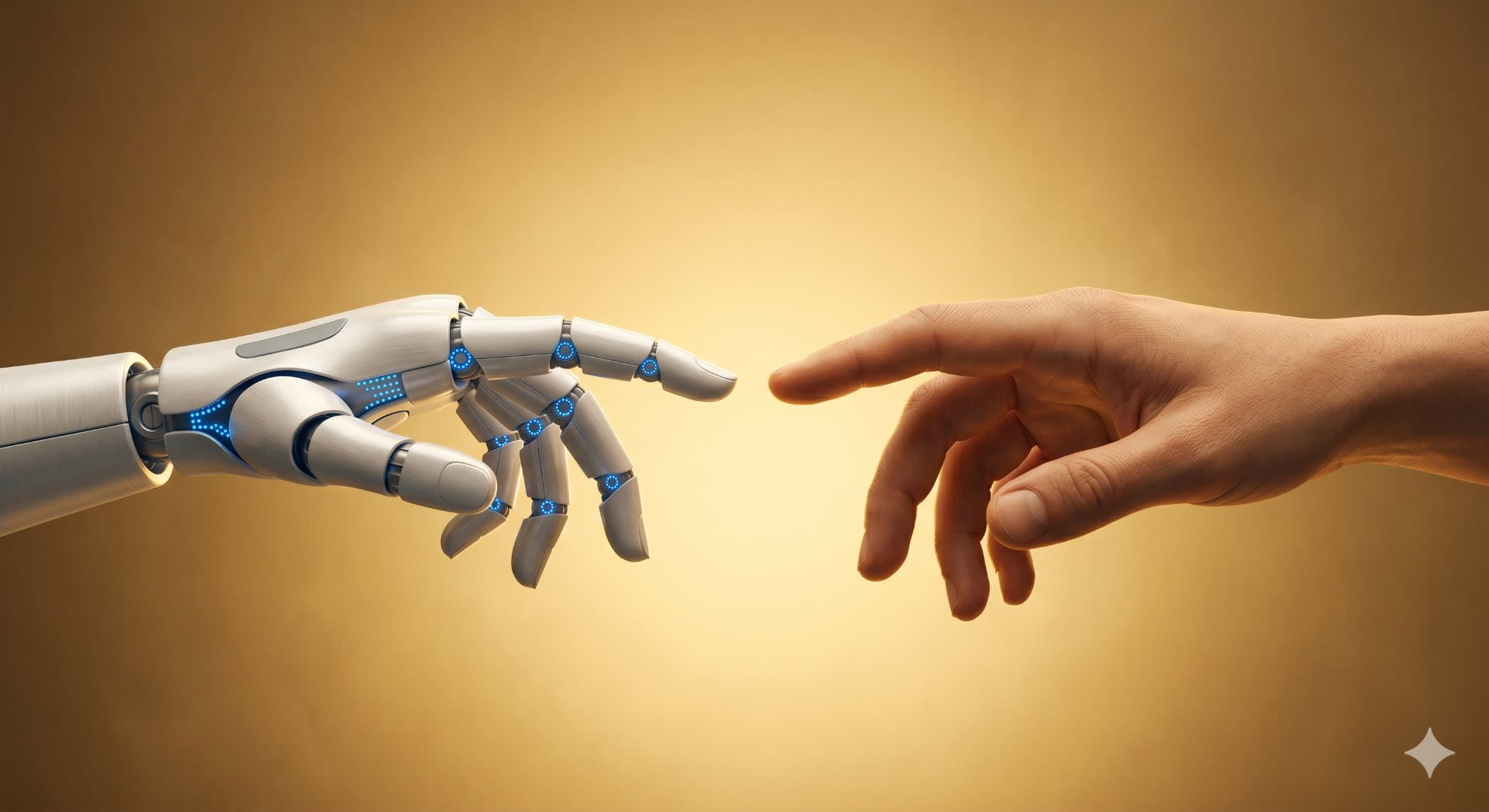
There's a word you'll hear in every meeting, every quarterly review, every leadership town hall these days: efficiency.
And for millions of people working in support roles — customer support, technical support, operations — that word has quietly become the most frightening word in the English language.
How Support Teams Were Built — Before AI
Not long ago, a support organisation was built like a pyramid. You had frontline agents handling common queries. Above them, a layer of specialists for escalations. Above that, senior subject matter experts. Each tier existed because human problems were unpredictable, nuanced, and volume-heavy. You needed people — a lot of them — just to keep the machine running.
This wasn't inefficiency. It was design. Every escalation path, every Level 1 and Level 2 handoff, every team lead reviewing tickets — it all existed because people need people to solve their problems.
Then AI arrived.
The Gradual Shrinking Nobody Announced
It didn't happen overnight. Nobody sent a memo saying "we're replacing the team." It was slower than that, and honestly, that made it worse.
First, a bot handled the repetitive FAQ tickets. Then AI started drafting responses that agents just reviewed and sent. Then the review queue shrank. Then headcounts weren't backfilled when someone left. Then came the reorg.
At each step, leadership pointed to the same metric: efficiency. Response times improved. Volume per agent went up. Costs came down. On a dashboard, it looked like progress.
What the dashboard didn't show was the mood inside the team.
When "Efficiency" Becomes a Loaded Word
If you work in support right now and you heard your manager say "AI is making us more efficient," I'd bet you felt something tighten in your chest. Not excitement. Not pride.
Fear.
Because you've figured out the translation: efficiency means fewer people are needed to do the same work. And the question everyone is asking themselves — usually quietly, never out loud — is will I be the next one who isn't needed?
This is the psychological reality of AI adoption that no case study ever captures. The productivity metrics go up. Employee trust goes down. People start competing to look irreplaceable instead of collaborating to do their best work. The team technically performs better and functionally falls apart.
The Cruel Irony: AI Made the Job Harder
Here's what I didn't expect — and I suspect a lot of support professionals feel the same way.
AI was supposed to reduce the mental load. Handle the boring stuff. Free us up for complex, meaningful work.
Instead, it raised the bar for everything.
Before AI, if you handled 30 tickets a day well, that was a solid shift. Now that AI can handle 30 routine tickets automatically, your job is the difficult 30 — the edge cases, the frustrated customers, the multi-system issues. Every ticket in your queue is harder than the one you used to dread most.
The expectation didn't stay the same. It moved.
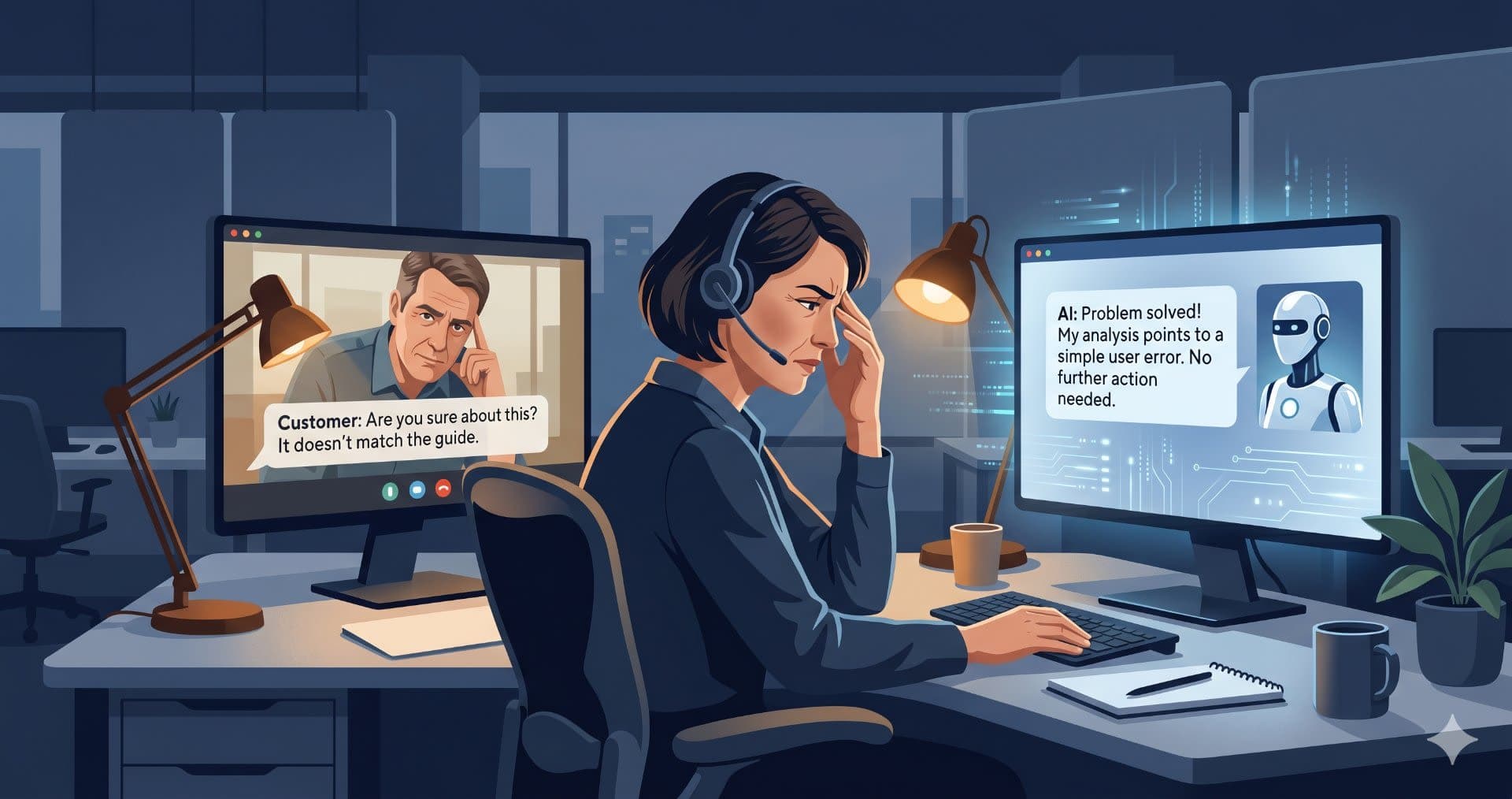
And the part that doesn't get said enough: when AI assists you and something goes wrong, the blame still lands on you. The AI didn't apologise to the customer. You did.
The Hallucination Problem Is Real — And It's Exhausting
Let's talk about something that support teams deal with every single day but that rarely makes it into the productivity reports: AI hallucination.
These tools — even the paid, enterprise-grade ones — confidently produce wrong answers. They generate summaries with invented details. They reference policies that don't exist. They suggest solutions that would make the problem worse. And they do it with the same calm, authoritative tone they use when they're correct.
So you check the output. You spot something odd. You go back to the source. You cross-reference. You check again.
Here's the part that genuinely unsettles me: when I ask an AI to review its own previous output for errors, it often responds with something like — "Good catch, you're right, I missed that."
Why didn't it catch that the first time?
If the model is capable of identifying the mistake when asked to look, why did it present the flawed answer with full confidence to begin with? That gap — between what the AI can catch and what it does catch — is where support professionals are losing hours every week.
You end up with a workflow that goes: AI produces output → human validates → human finds issue → AI agrees there's an issue → human wonders what else they missed → validate again. The validation loop never ends. What looked like a time-saver became a time multiplier for double and triple checks.
False Positives Are Killing Productivity
There's another cost that doesn't show up in the efficiency metrics: false positives.
AI systems flag issues that aren't issues. They escalate tickets that don't need escalation. They mark cases as resolved when they aren't. In a high-volume support environment, even a 5% false positive rate creates a second full-time job just managing the noise.
And here's the trap: if you ignore the flags, you risk missing a real issue. So you don't ignore them. You check every one. Which means the system that was supposed to reduce your workload is quietly generating additional workload — it's just harder to measure and therefore easier to overlook in a board presentation. Building productivity strategies that suit your work style can help you manage the noise without burning out.
What Nobody Is Asking Support Teams
Here's what I think is missing from most of these AI implementation conversations: nobody is actually asking the people doing the work how they feel about it.
Not performatively, in a town hall where you can't answer honestly. Actually asking.
Because if they did, I think they'd hear things like:
"I feel like I'm always behind now, even when I'm working harder than I ever have."
"I don't trust the AI output enough to use it quickly, but if I take too long double-checking, I get flagged for low efficiency."
"I'm scared that if I raise concerns about the AI being unreliable, I'll be seen as resistant to change."
These aren't lazy employees resisting new technology. These are skilled professionals caught between a tool they're expected to trust and real-world evidence that trust hasn't been fully earned yet.
The Path Forward Isn't More AI — It's Better Integration
I'm not saying AI in support is wrong. I'm saying the rollout has been backwards.
Most organisations deployed the tool and then figured out the workflow. The right way is the opposite. You define what good looks like. You identify which tasks the AI genuinely handles well without human babysitting. You build validation processes that are sustainable, not just "the human checks everything." And you have honest conversations with the team about what's changing and why.
AI should reduce the tedious parts of support work — the copy-paste ticket responses, the status updates, the routing. It should not increase the psychological burden on the people doing the complex, human-judgment work that remains.
The future of remote and hybrid work makes this even more urgent — as teams grow more distributed, the gap between AI promises and human reality only widens. Until organisations close that gap, support teams will keep doing what they're doing now: working harder, trusting less, and quietly worrying about what the next round of "efficiency improvements" will mean for them.
And none of that shows up in the dashboard.