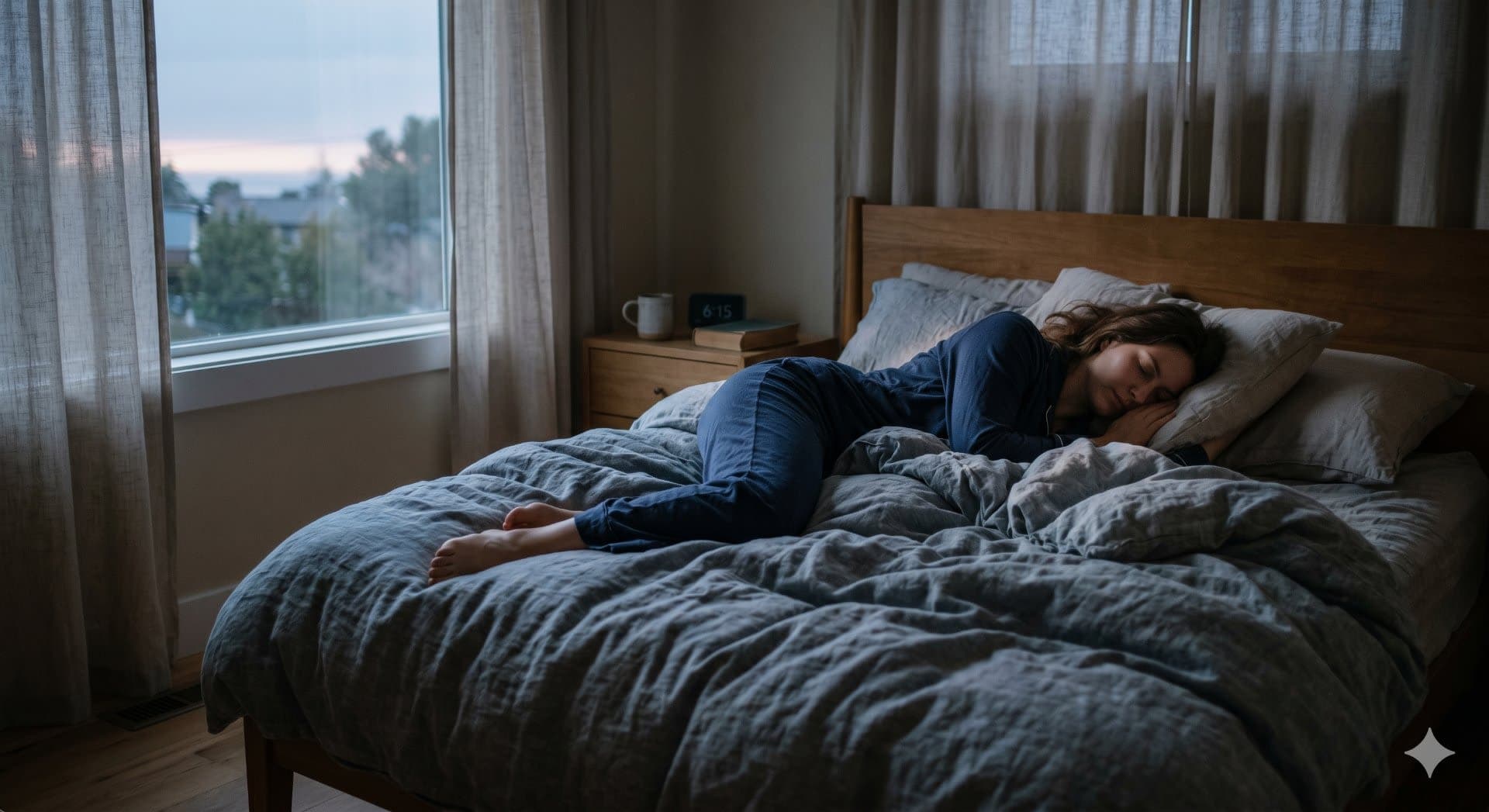
You set the alarm for 6 AM. You got into bed at 9 PM. Nine hours, you thought. Nine whole hours. And yet you woke up feeling like you'd been hit by something. Groggy. Heavy. The kind of tired that a cup of chai doesn't touch.
This is more common than you think. And it points to something most sleep advice misses entirely: the problem isn't usually how long you sleep. It's what happens during those hours.
Quality Over Quantity — And Why That's Not Just a Saying
Sleep isn't a single state. Your brain cycles through distinct stages throughout the night — light sleep, deep sleep, and REM (rapid eye movement) sleep — in roughly 90-minute cycles. Deep sleep is when your body repairs tissue, consolidates immune function, and clears metabolic waste from the brain. REM is when memory consolidation happens, when emotional processing occurs, when the brain essentially defragments itself.
Disrupt those cycles and it doesn't matter if you're in bed for seven hours or eleven. You'll still wake up feeling terrible.
A 2019 study published in Sleep Medicine found that sleep fragmentation — waking briefly multiple times through the night, often without remembering it — was more strongly linked to next-day cognitive impairment than total sleep duration. You can sleep "enough" and still feel wrecked if the architecture is broken.
So the real question isn't "how do I sleep more?" It's "how do I stop sabotaging the sleep I already get?"
Temperature: The Underrated Variable
Most people focus on noise and light. Temperature is the one they ignore, and it's arguably the most important physical factor in sleep onset and sleep depth.
Your core body temperature needs to drop by about 1–2°C for you to fall asleep. This is why you yawn when you're cold — it's partly a cooling mechanism. A warm room actively fights this process. Research from the National Sleep Foundation suggests the optimal sleeping environment sits between 15–19°C (60–67°F). For most Indian homes in summer, that number is quietly devastating.
You don't necessarily need air conditioning. A fan aimed to circulate air works. So does a lukewarm shower before bed — counterintuitively, it pulls heat to the surface of your skin, then dissipates it quickly, dropping your core temperature faster than skipping the shower.
Light cotton sheets. Windows cracked open when weather allows. These aren't luxuries. They're engineering your body toward sleep.
Alcohol: The Sleep Trap That Feels Like a Sleep Aid
This one needs to be said directly: alcohol does not help you sleep. It helps you pass out. These are not the same thing.
Even a single drink — one beer, one glass of wine — measurably suppresses REM sleep, particularly in the first half of the night. A 2018 meta-analysis in JMIR Mental Health analyzing data from 700,000 people found that even low alcohol consumption reduced sleep quality by 9.3%. Moderate consumption reduced it by 24%.
What alcohol does is sedate you into the early stages of sleep quickly, then bounce you awake in the second half of the night as it metabolizes. This is why people who drink "fall asleep fine" but wake at 2 or 3 AM and can't get back to sleep. The deep, restorative stages — the ones that actually matter — are being cut short.
And yes, this applies even if you don't feel drunk. Even if you "sleep fine." The architecture data says otherwise.
Screens, Light, and the Melatonin Problem
You've heard the screen advice. You've probably ignored it. Here's why it's worth taking seriously.
The issue isn't that screens are "stimulating" in some vague psychological sense. The issue is specific: blue-wavelength light, emitted by phone and laptop screens, directly suppresses melatonin production by signaling your brain that it's still daytime. A 2014 study from Harvard found that using a light-emitting device for a few hours before bed delayed melatonin release by 90 minutes and shifted the circadian clock by up to three hours.
Three hours. Think about that. You sleep at midnight, but your body thinks it's 9 PM.
Night mode and warm-toned screen filters help, but they don't eliminate the problem. The more honest fix is a hard cutoff — no screens for at least 60–90 minutes before you want to sleep. This is genuinely hard. Most people won't do it. But the ones who try it for two weeks consistently report a difference in how quickly they fall asleep and how rested they feel.
Physical books. A dimly lit room. Conversation. These things aren't nostalgic nonsense — they're actually effective.
Timing Inconsistency: The Sleep Debt Nobody Talks About
Sleep 10 PM Monday. Sleep 1 AM Tuesday. Sleep midnight Wednesday. Wake up at different times each day depending on whether it's a workday.
Your circadian rhythm is a biological clock. It expects consistency. When you vary your sleep schedule by more than 60–90 minutes from day to day, you're essentially giving yourself mild social jet lag — the same disruption as crossing one or two time zones, on repeat.
Research from the University of Michigan found that irregular sleepers had significantly worse mood, higher rates of depression and anxiety, and worse metabolic health than people who slept the same total hours but at consistent times. It's not just about how much you sleep or even how well. It's about when.
Your wake time matters more than your sleep time. Set a consistent wake time and hold it — weekends included. Your body will start anticipating sleep at a corresponding time naturally, within a few weeks.
Painful? Yes. Especially on Saturday. But it's the single highest-leverage change most people can make.
The Honest Part
Everything above is real and evidence-backed. But here's what I'd be doing you a disservice by not saying: lifestyle changes don't fix sleep disorders.
If you've tried consistent timing, cooled your room, cut alcohol, reduced evening screen exposure — genuinely tried, for weeks — and you still wake up exhausted, that's not a discipline problem. It's a medical signal worth taking seriously.
Sleep apnea affects an estimated 1 in 5 adults and is wildly underdiagnosed, especially in India. It causes hundreds of micro-arousals per night that you won't remember but your body absolutely notices. Insomnia disorder — clinical insomnia, not "I had a bad few nights" — responds best to Cognitive Behavioural Therapy for Insomnia (CBT-I), not melatonin supplements or white noise machines. Restless leg syndrome, periodic limb movement disorder, circadian rhythm disorders — these are real conditions, not symptoms of insufficient discipline.
The wellness content industry has a bad habit of implying that poor sleep is entirely a lifestyle and habit problem — something you can hack your way out of with the right supplement stack and morning routine. Sometimes it is. Often there's more going on. A sleep study (polysomnography) costs money and requires effort, but if you've been chronically unrefreshed for months, it's the right next step, not another podcast episode about sleep hygiene.
Go see a doctor. Not because you've failed, but because some problems genuinely require medical attention and no amount of blackout curtains will fix them.
What You Can Actually Do Tonight
Start with one thing. Not five. One.
Pick the variable you're most obviously ignoring — alcohol close to bedtime, wildly inconsistent sleep schedule, room that's hot enough to bake bread in, scrolling until you physically pass out — and address that first. Give it two weeks of actual consistency before judging the results. Sleep changes don't happen overnight (the irony of that phrase). The circadian system adapts slowly.
Then add the next variable. And the next.
The goal isn't a perfect sleep routine. It's stopping the things that are actively breaking the sleep you already have. Your brain wants to give you deep, restorative sleep — it's built for it. You're mostly just getting in the way.
Nine hours in bed is not the same as nine hours of sleep. But four hours of uninterrupted, properly cycled sleep can do more for you than eight hours of fragmented, alcohol-suppressed, overheated half-rest.
That's not inspiration. That's just biology.