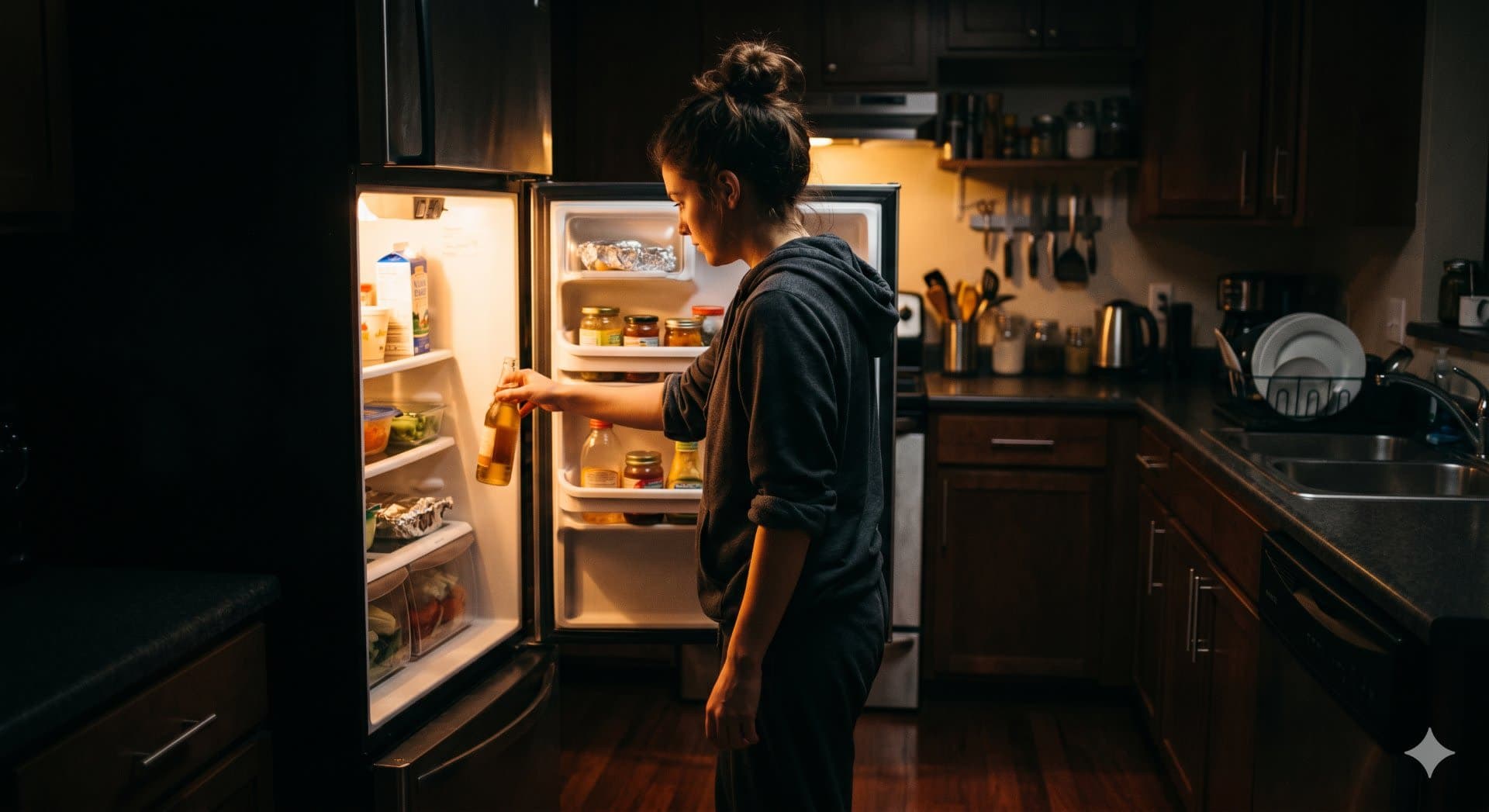
It's 11:07pm. You've brushed your teeth, you're in bed, and then — there it is. That pull. Not exactly stomach-growling hunger, but something. You find yourself standing in front of an open fridge, bathed in pale light, staring at leftover dal and a half-eaten packet of biscuits. You weren't hungry an hour ago. You're not even sure you're hungry now. But you eat anyway.
Most people recognise this scene. And most people feel vaguely ashamed of it, which is the first problem with how we talk about late-night eating. We treat it as a willpower failure. It almost never is.
Emotional Hunger vs. Physical Hunger — The Research Is Clearer Than You Think
Physical hunger builds slowly. It responds to most foods. It stops when you're full. Emotional hunger, on the other hand, arrives suddenly, targets specific foods — usually dense, high-fat, high-sugar ones — and doesn't really resolve even after eating.
A 2013 study published in Obesity found that nighttime eaters reported significantly higher levels of depression, lower sleep quality, and greater impulsivity than people who ate during conventional hours. The food wasn't the variable. The emotional state was. What looks like a craving for chips or chocolate is often a craving for relief — from stress, from boredom, from the low-grade anxiety that quietly accumulates through a day full of obligations.
And here's the thing: your brain isn't lying to you when it sends that signal. It's just using the wrong vocabulary.
The reward circuitry in the brain — the dopamine system — is genuinely activated by palatable food. At night, when you're tired and your prefrontal cortex (the part that weighs consequences) is running low on resources, that reward system has considerably less competition. You're not weak at 11pm. You're neurologically depleted.
Cortisol, Sleep, and the Biology You Can't Simply Willpower Your Way Past
Cortisol is your body's primary stress hormone, and it follows a daily rhythm. It should be highest in the morning — giving you energy and alertness — and lowest at night, allowing your body to wind down toward sleep. But chronic stress disrupts this rhythm completely.
When cortisol remains elevated into the evening, it does several things. It suppresses leptin, the hormone that signals fullness. It elevates ghrelin, the hormone that signals hunger. And it specifically increases cravings for calorie-dense foods, because from your body's evolutionary standpoint, stress means danger, and danger means you might need emergency fuel.
Your body thinks it's preparing for a threat. You're just trying to get through Tuesday.
Research from the University of Pennsylvania found that people who were sleep-deprived consumed an additional 550 calories per day on average, with the majority of those extra calories eaten between 11pm and 4am. Sleep loss and late-night eating aren't separate problems — they're the same problem feeding itself. Poor sleep increases hunger hormones. Eating late disrupts sleep quality. Round and round it goes.
The Restriction Cycle — Why Dieting Often Makes It Worse
Here's where it gets genuinely uncomfortable to talk about, because the standard advice is usually "eat less" or "avoid snacking after 8pm." That advice, for a significant portion of people, makes the midnight eating worse. Not better.
If you spend the day restricting — skipping breakfast, eating a sad desk salad at lunch, having a "sensible" dinner — you've spent twelve to fourteen hours sending your body scarcity signals. By 11pm, your body isn't being irrational when it screams for food. It's responding rationally to what it experienced that day.
The more rigid the daytime restriction, the more intense the nighttime pull. This is the dietary restraint paradox, documented in dozens of studies over the past four decades. You can't out-discipline biology for long. At some point, the body takes what it was owed.
The irony is profound: the people most committed to eating "cleanly" are often the ones most prone to chaotic nighttime eating. Not because they're weak. Because restriction creates the exact neurological and hormonal conditions that guarantee a rebound.
It Often Has Nothing to Do With Food at All
Night is when the noise stops. That sounds like a good thing. But for a lot of people, the noise — the meetings, the commute, the children, the tasks — was also covering something. Loneliness. Grief. The low hum of a life that feels slightly off-track. When quiet arrives, so does everything you didn't have bandwidth to feel during the day.
Food is immediate. It's sensory. It works right now, which is more than can be said for most solutions to difficult emotions. A clinical psychologist named Dr. Jennifer Taitz describes this as using food as a "short-term emotion regulation strategy" — it's not pathological or bizarre, it's an understandable human response to discomfort with no better available tool in that moment.
The question worth sitting with isn't "how do I stop eating at night?" It's "what am I actually trying to get from this?" Sometimes it's comfort. Sometimes it's procrastination. Sometimes it's the only moment of pleasure in a day that felt relentlessly transactional. When you know what you're actually seeking, you at least have the option of finding a different path to it. Maybe that's a ten-minute walk. Maybe it's calling someone. Maybe, sometimes, it actually is eating something — and that's fine too.
Practical Patterns That Actually Help (And Why They Work)
There are real interventions here, but they work best when you understand the mechanism behind them rather than following them as rigid rules.
- Eat enough during the day. Not a diet-culture "enough." Actually enough. If you're hitting the kitchen at 11pm three nights a week, look at what you ate between 7am and 7pm first. The solution might be lunch.
- Identify the emotional trigger, not just the time. Is it after stressful phone calls? After doom-scrolling? After specific conversations? Patterns are information. You can't address what you haven't named.
- Create a wind-down ritual that competes with snacking. Not because snacking is evil, but because a hot shower, a specific tea, ten minutes of reading — these activate the parasympathetic nervous system in ways that genuinely reduce cravings. The competition is neurological, not moral.
- If you're going to eat, eat something with protein. A handful of nuts, a small portion of paneer, some yogurt — protein increases satiety hormones and is less likely to spike blood sugar in ways that further disrupt sleep architecture. Not a perfect solution, but a meaningfully better one than a sleeve of biscuits.
- Look at your sleep debt. Seriously. If you're averaging five or six hours of sleep and wondering why your cravings are out of control, no amount of discipline will fix what only sleep can fix.
The Honest Part: When This Isn't a Lifestyle Problem
Night Eating Syndrome is a real clinical condition, affecting an estimated 1.5% of the general population and considerably higher rates among people with obesity or eating disorders. It's characterised by consuming more than 25% of daily caloric intake after dinner, frequent nocturnal awakenings that involve eating, morning anorexia, and significant distress. It's not the same as occasionally raiding the fridge.
And there's more. Sleep-related eating disorder — different from Night Eating Syndrome — involves people eating during partial arousal from sleep, sometimes with no conscious memory of it. This is a parasomnia. A sleep disorder. Journaling your feelings and eating more protein for lunch will not address it.
Some people have genuinely disrupted circadian systems — shift workers, people with delayed sleep phase disorder, individuals with certain mood disorders — where the standard advice about "eating earlier" is simply incompatible with how their bodies and lives function.
The wellness space is filled with confident prescriptions for midnight eating that assume the problem is straightforward. Often it is. But not always, and pretending otherwise does a disservice to people whose experience is more complicated. If you've tried the reasonable lifestyle adjustments and the pattern persists intensely — with significant distress, weight impact, or nocturnal awakening specifically to eat — that warrants a conversation with a doctor, not another Pinterest wellness infographic.
What You're Actually Asking For
The midnight kitchen raid, in most cases, is not about food. It's about rest, relief, comfort, or simply the only quiet moment in a day that gave you no room to breathe. Your body isn't broken. It's communicating, just with the tools it has available.
The most useful shift isn't "how do I stop this?" It's "what does this tell me about my day?" If the answer is that your days are too depleted, too restricted, too devoid of genuine rest and pleasure — then that's what needs addressing. The biscuits at 11pm are a symptom. And symptoms, when you listen to them instead of just suppressing them, are actually useful.
Eat the snack if you need to. And then, when you have more bandwidth, get curious about what the snack is standing in for.