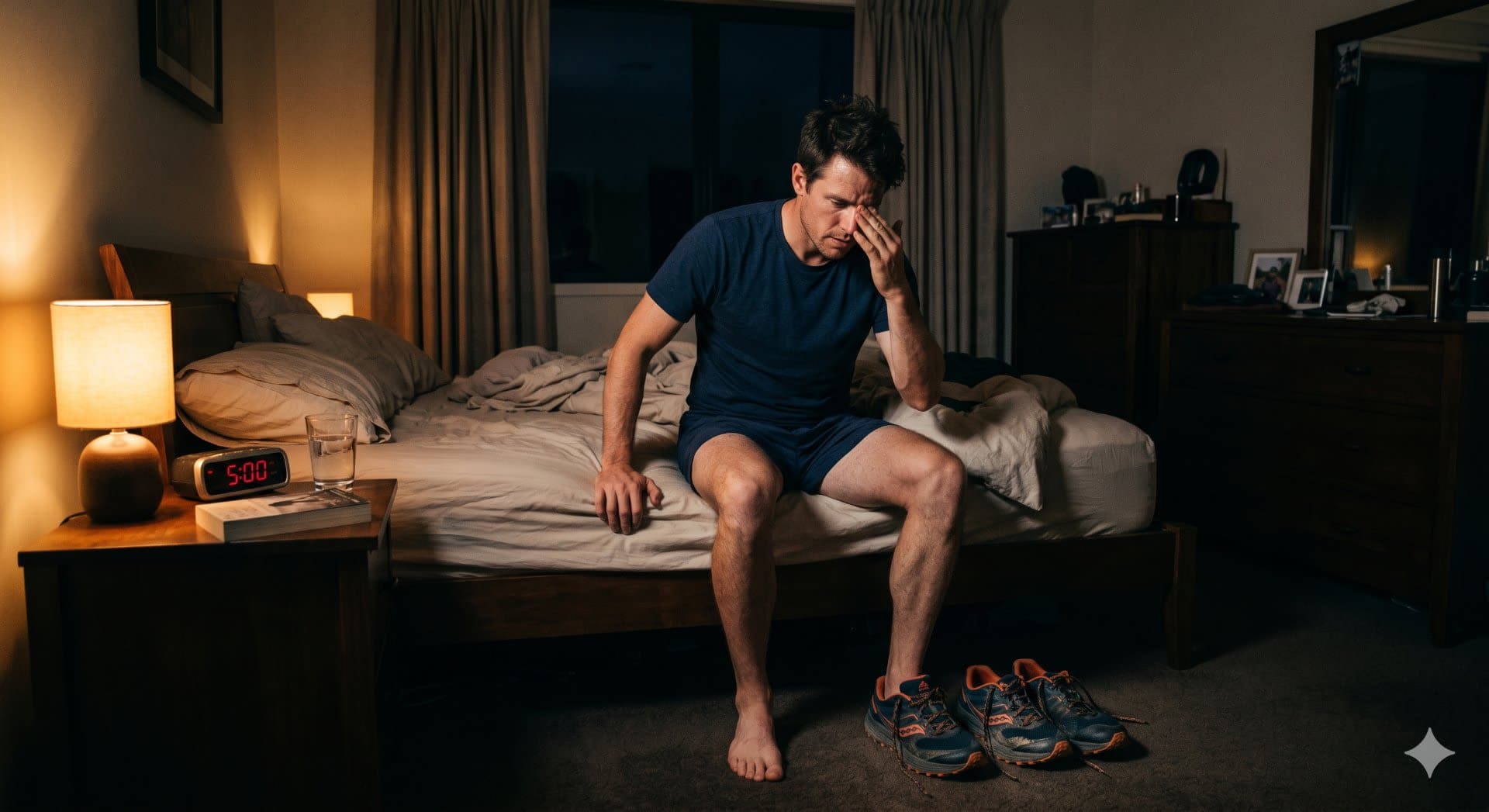
It's 6 a.m. on a Tuesday in January. Two people set identical alarms the night before. Same goal: wake up early, exercise, get ahead of the day.
The first person hits snooze. They were motivated last night — genuinely excited. But this morning, it's cold. They're tired. The feeling isn't there. So they wait for it to come back. It doesn't. They sleep another 45 minutes and spend the rest of the morning telling themselves tomorrow, definitely tomorrow.
The second person also doesn't feel like getting up. But they get up anyway. Not because they're a morning person. Not because they love exercise. They get up because getting up is just what they do on Tuesdays. The decision was already made. There's nothing to debate.
That gap — between the person who waits for motivation and the person who just moves — is the entire argument for discipline.
The Motivation Myth We Keep Falling For
Motivation is a feeling. And feelings are unreliable narrators.
They spike when you watch an inspiring video, read a great book, or have a conversation that lights something up in you. For a few hours, maybe a few days, you're unstoppable. You plan. You start. You tell people about it.
Then the feeling fades. Because that's what feelings do.
Research published in the British Journal of Health Psychology found that motivational intention had almost no relationship to whether people actually followed through on exercise over time. What mattered was whether they had a specific implementation plan — a when, where, and how. Not how much they wanted to do it. When.
Motivation is a great starting gun. It's a terrible engine.
Discipline Is Not a Personality Trait
Here's the story we tell ourselves about disciplined people: they were born that way. They have more willpower. They don't struggle the way the rest of us do.
Wrong. Completely wrong.
Roy Baumeister's famous ego depletion research suggested that willpower is like a muscle — it fatigues with use. More recent work has complicated this, but the core insight holds: the most disciplined people aren't the ones who rely on willpower. They're the ones who've built systems that require the least willpower possible.
James Clear talks about this extensively in Atomic Habits: "You do not rise to the level of your goals. You fall to the level of your systems." Disciplined people aren't fighting their impulses all day. They've designed their environment so the right choice is also the easy choice.
That's not a personality trait. That's architecture.
Discipline as a System: Three Things That Actually Work
So how do you build it? Not by gritting your teeth harder. Here are three approaches that have real evidence behind them.
Identity-Based Habits
The fastest way to change behavior is to change how you see yourself. Not "I'm trying to exercise more" but "I'm someone who moves their body every day." Not "I'm quitting junk food" but "I don't eat that stuff."
It sounds like a small reframe. It isn't. When a behavior is tied to identity, skipping it creates cognitive dissonance. You're not breaking a rule — you're betraying who you are. That's a much stronger pull.
Start small enough that the identity claim is easy to prove true. Five minutes of reading makes you a reader. One paragraph makes you a writer. Accumulate evidence for the identity, and the behavior follows.
Environment Design
Willpower doesn't scale. Environment does.
Put your running shoes next to your bed. Remove Instagram from your phone's home screen. Leave the book on your pillow. Put the fruit on the counter and the chips in a hard-to-reach cabinet.
Stanford researcher BJ Fogg calls this "motivation wave" dependency — most people try to time their behaviors to peaks of motivation. Fogg's research shows that environment design consistently outperforms motivational strategies over time. Make the desired behavior the path of least resistance. Make the undesired behavior slightly harder to access. That's it.
Micro-Commitments
Don't commit to the outcome. Commit to showing up in the smallest possible way.
Not "I'll write a chapter this week." But: "I'll open the document every morning." Not "I'll go to the gym for an hour." But: "I'll put on gym clothes at 7 a.m."
The psychological research on this is called the "two-minute rule" in habit literature, but the deeper mechanism is behavioral activation — the act of starting creates its own momentum. You open the document, and usually you write something. You put on the clothes, and usually you go. The barrier isn't the action. It's the decision to begin.
Micro-commitments make beginning nearly frictionless. And beginning is everything.
Why Consistency Matters More Than Intensity
People dramatically overestimate what they can do in a week and underestimate what they can do in a year. Motivation drives intensity. Discipline drives consistency. And in almost every domain that matters — health, skills, relationships, creative work — consistency wins.
A study published in European Journal of Social Psychology found that habit formation takes an average of 66 days, not the widely cited 21 days. More importantly, missing a day occasionally didn't significantly affect the long-term habit formation. What mattered was not missing twice in a row. One missed day is an anomaly. Two is the start of a new pattern.
Disciplined people aren't perfect. They just have a short recovery time.
They don't spiral when they miss a workout. They don't catastrophize when they eat badly one day. They have a rule: never miss twice. That's the whole system.
The Honest Part
Discipline can become a cage.
There's a version of this advice that, taken too far, produces rigid, joyless people who follow their systems at the expense of spontaneity, connection, and rest. Who refuse to take a day off because it breaks the streak. Who can't enjoy a holiday because it disrupts the routine. Who confuse consistency with inflexibility.
That's not discipline. That's anxiety dressed up as productivity.
Real discipline includes the wisdom to know when to bend. The person who can hold a long-term habit loosely — who can miss a day without shame and skip a routine for a reason worth skipping it for — is more disciplined than the one who follows the system mechanically and breaks down when life doesn't cooperate.
There's also a class dimension worth naming: building discipline is easier when your environment is stable, your basic needs are met, and you're not spending your energy managing chronic stress or financial precarity. Telling someone in a chaotic or unsafe situation to just "build better systems" is tone-deaf. Discipline advice, like most self-help advice, tends to assume a level of stability that not everyone has. That's worth acknowledging honestly.
What This Actually Looks Like Day to Day
Forget the 5 a.m. routines and cold showers and hustle-culture performativity. That's not what discipline looks like for most people living real lives.
It looks like doing the work when you don't feel like it — not heroically, just quietly. It looks like having a default answer to "what do I do at 7 p.m.?" so you're not making that decision from scratch every night. It looks like small choices that compound over months: the reading habit, the daily walk, the ten minutes of focused work before you open email.
It looks boring from the outside. It feels boring from the inside, at first. And then, somewhere around month three or four, something shifts. The behavior stops requiring effort. It becomes who you are.
That's the whole secret, really. Discipline starts as a practice you do. It ends as a thing you are. The goal isn't to motivate yourself forever. The goal is to need motivation less and less.
Motivation says: I'll do it when I feel ready. Discipline says: I don't need to feel ready.
One of them will get you somewhere. The other will keep you waiting.